After Dark in the Asphalt: The Parking Lot Night Markets Quietly Rewriting American Food Culture
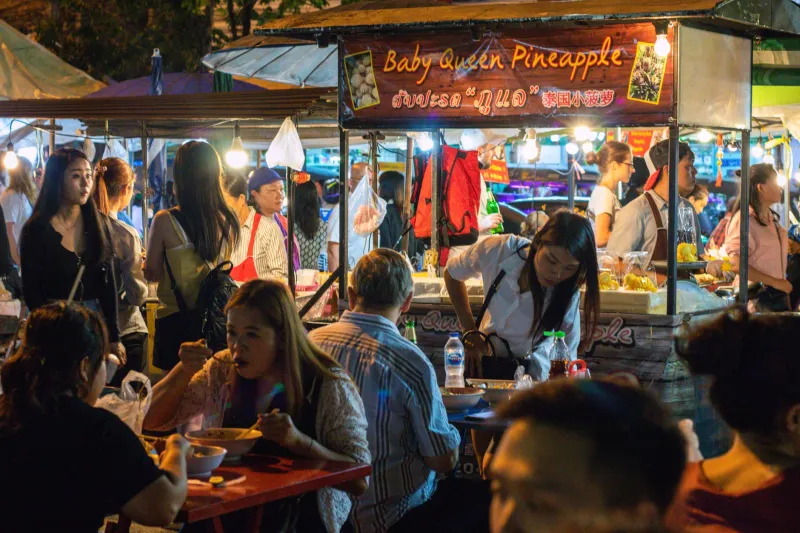
Somewhere between the hours of 7 p.m. and midnight, in a parking lot you probably drive past without thinking about it, something remarkable is happening. String lights are going up. Generators are humming. The smell of char-grilled meat and fresh-fried dough is starting to drift across an otherwise unremarkable stretch of asphalt. And several hundred people who know exactly where to be are making their way there.
This is the American night market in its truest form — not the curated, ticketed, sponsor-heavy version that gets written up in lifestyle magazines, but the grassroots, word-of-mouth, cash-in-hand version that's been quietly transforming overlooked urban spaces into the most culturally alive destinations in their cities.
Why Parking Lots?
The question answers itself once you think about it. Commercial real estate is expensive and heavily regulated. Brick-and-mortar restaurants require capital that most immigrant families and indie food entrepreneurs simply don't have access to. Health permits, lease agreements, buildout costs — all of these create barriers that function, whether intentionally or not, as filters against the exact communities whose food cultures are most interesting.
A parking lot, on the other hand, is flexible. It's temporary. It's negotiable. And in many cities, a few key relationships with a property owner or a sympathetic church, temple, or community organization can unlock a space that becomes something extraordinary a few nights a week.
"We're not trying to be a restaurant," says one vendor at a Houston-area market who's been running a Viet-Cajun fusion stall for three years. "We're trying to be a gathering place. The food is just the reason people show up."
Houston's Invisible Night Economy
The greater Houston area has one of the most diverse populations in the United States, and its unofficial night market circuit reflects that complexity in ways that no single restaurant district could. On certain Friday and Saturday nights, a cluster of vendors sets up in a strip mall parking lot off Bellaire Boulevard in the city's Chinatown corridor, running everything from Taiwanese beef noodle soup to Salvadoran pupusas to Nigerian suya skewers.
There's no central website. The location gets confirmed through a combination of community Facebook groups, WeChat channels, and the kind of neighborhood knowledge that doesn't translate to Google Maps. If you know, you know.
What makes this particular market work isn't just the food — it's the social architecture. Families set up folding tables. Kids run between vendor stalls. Older men play cards at the edge of the lot while a Bluetooth speaker somewhere runs a playlist that moves from Vietnamese pop to cumbia to Afrobeats without anyone asking it to make sense. It just does.
"This is what the neighborhood actually is," says one regular attendee, a second-generation Vietnamese-American who grew up nearby. "Not what it looks like on Yelp."
The Portland Lot That Became a Landmark
In Portland, Oregon, a rotating night market that started in a Northeast Portland parking lot has grown into one of the city's most talked-about cultural events — mostly among the people who actually go to it. The market, which centers on Southeast Asian and Pacific Islander food vendors, has been running for several years with minimal mainstream press coverage and zero corporate sponsorship.
The organizers made that choice deliberately. "The moment you take sponsor money, you start making decisions for the sponsor," says one of the co-organizers, who runs a Filipino dessert stall alongside managing the logistics. "We wanted to stay ours."
The market has become a proving ground for vendors who've gone on to open brick-and-mortar spots, a platform for local musicians who perform on a makeshift stage near the food stalls, and a weekly ritual for a community that doesn't always see itself reflected in the city's more prominent food culture.
It's also, quietly, one of the best places to eat in Portland. But the organizers aren't particularly interested in that reputation spreading too far too fast.
Atlanta's After-Hours Hustle
In Atlanta, the night market energy takes on a different character — faster, louder, more explicitly tied to the city's broader creative underground. A market that operates in a west Atlanta parking lot on select Saturday nights functions as much as an art and music event as a food destination. Vendors selling handmade jewelry and vintage clothing set up alongside food stalls. A local DJ runs sound from the back of a truck. At least one vendor is always selling something that doesn't quite fit a category.
The Atlanta market draws a majority Black crowd and operates with an aesthetic sensibility that's clearly informed by the city's deep cultural history — there's a thread connecting this parking lot to the cookouts, the block parties, the outdoor fish fry traditions that have always been the real social infrastructure of Black Atlanta.
"People act like this is new," says one longtime vendor. "Black people have been doing night markets forever. We just didn't call them that."
The Gentrification Clock Is Already Ticking
Here's the part that's hard to ignore: every market profiled in this piece exists in a state of precarity. Zoning pressures, rising property values, noise complaints from newly arrived residents, and the attention of city governments that see these spaces as either a liability or an opportunity to rebrand a neighborhood — all of these forces are already in motion.
The history of American urban culture is littered with the remains of scenes and spaces that got loved to death by the mainstream. The underground becomes culture, culture becomes content, content becomes a brand, and somewhere in that process the people who built it get priced out.
The vendors and organizers who run these markets know this. Most of them are building with one eye on the horizon, trying to extract as much community value as possible before the window closes.
Show Up While It's Still Real
The thing about these markets is that they don't need your think piece. They were doing fine before you got here. But if you're in one of these cities — or passing through — and you have the presence of mind to find one, go. Bring cash. Talk to the vendors. Eat something you can't pronounce. Stay until the generator cuts off.
This is what American food culture looks like when it's not performing for anyone. It's messy and multilingual and occasionally operating out of a cooler in someone's truck bed, and it is absolutely the most interesting thing happening in your city right now.
You just have to know where the parking lot is.