Fix, Stop, Wash, Repeat: The Basement Darkrooms Keeping Analog Photography Breathing
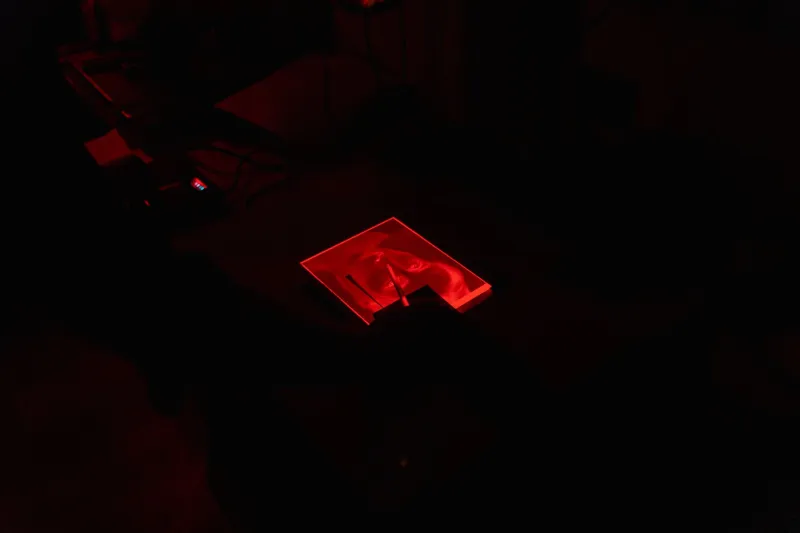
There's a particular kind of quiet that lives inside a darkroom. Not silence exactly — there's the soft lap of chemistry in trays, the occasional creak of a timer, someone breathing steadily in the red-orange glow of a safelight. It's the quiet of concentration. Of waiting for something real to appear.
You won't find these rooms on Yelp. You probably won't find them on Instagram either, which is sort of the point. Across the country, a scattered but surprisingly connected network of underground film labs and community darkrooms is doing exactly what the dominant culture said couldn't survive: developing film, printing chemically, and building tight-knit communities around the whole slow, deliberate process.
The Lab That Doesn't Advertise
Take the kind of operation that exists in a city near you, even if you don't know it yet. A converted basement. A hand-lettered sign on the door that you'd only know to look for if someone told you. Inside: four enlargers, a row of developing tanks, a drying cabinet made from a repurposed wardrobe, and a whiteboard covered in shift schedules and chemical mixing ratios.
These labs run on word of mouth, modest membership fees, and the genuine enthusiasm of the people who show up. Some are attached to artist collectives. Some started as one person's home setup that quietly expanded until the neighbors started asking questions. A few operate out of back rooms in record shops or community print studios — spaces already oriented toward the physical, the tactile, the made-by-hand.
What they share is a rejection of convenience as the highest value. Film photography isn't convenient. It's not supposed to be. Every frame costs something — money, attention, the irreversible commitment of pressing the shutter. Development adds another layer of investment. And printing? Printing is where the real time disappears.
Why Now, Why Chemical
The resurgence of film photography has been documented plenty. Sales of 35mm cameras. Kodak reissuing stocks. The TikTok aesthetics. But what doesn't get covered as much is the deeper pull — the part that goes past vintage vibes and into something closer to philosophy.
Talk to anyone who's been shooting film seriously for a few years and you'll hear variations on the same thing: digital gives you infinite tries and somehow makes you less careful. Film gives you thirty-six frames and suddenly every one matters. The constraint is generative. The limitation is the point.
And development? That's where the magic gets chemical. Literally. The image that exists latent on a strip of exposed film — invisible, potential, waiting — gets coaxed out through a precise sequence of developer, stop bath, fixer, wash. Every step matters. Temperature, time, agitation. Get it right and you've made something. Get it wrong and you've learned something. Either way, you were present for it.
For a generation that grew up watching screens generate perfect images instantaneously, that presence feels radical.
Supply Chains Built From Scratch
One of the less-glamorous but genuinely impressive aspects of these underground labs is the supply infrastructure they've had to build themselves. Major photography retailers have largely abandoned chemical darkroom supplies. Kodak, Ilford, and a handful of European manufacturers still produce what's needed, but distribution in the US has gotten thin and expensive.
So these communities improvise. Group orders that pool buying power. Lab operators who drive hours to pick up surplus chemistry from closing school programs or commercial photo studios. Informal networks where someone in Portland tips off someone in Detroit that a batch of expired paper just became available for cheap. It's a supply chain that runs on trust, communication, and the shared understanding that if one lab goes under, the whole community feels it.
Some labs have started producing their own developers from scratch — sourcing raw chemicals, mixing to published formulas, testing obsessively. It's the kind of DIY that goes way past aesthetic preference into genuine self-sufficiency.
The Mentorship That Happens in the Dark
Maybe the most culturally significant thing happening in these spaces is the teaching. Darkroom work is inherently communal in a way that digital photography isn't. You can't really learn it from YouTube alone — the variables are too physical, too dependent on the specific conditions of a specific space. You need someone who's been there before, who knows that this enlarger runs hot, that this batch of paper needs an extra thirty seconds, that the water pressure in this building affects wash times.
So mentorship happens naturally. Veterans walk newcomers through their first developing session. Someone who's been printing for twenty years stands next to someone who's been doing it for two months and they figure out together why the highlights are blowing out. The knowledge transfer is slow, hands-on, and deeply human.
That's not an accident. It's the culture these spaces are actively building — one where expertise is shared rather than gatekept, where the point is to keep the craft alive rather than to maintain a monopoly on it.
What Gets Made Here
The work coming out of these labs is genuinely interesting, and not just because it's analog. There's a particular quality to chemically printed photographs that digital reproduction — even excellent digital reproduction — doesn't fully capture. The silver in the paper catches light differently. The tones move in ways that feel continuous rather than stepped. Prints made in community darkrooms carry the texture of their making.
And the photographers using these spaces are making work that reflects the intentionality of the process. Documentary work. Street photography with a kind of patience that digital shooting rarely requires. Portraiture that sits with its subjects rather than racing through setups. The slowness of the medium shapes the content.
Some of it gets shown in the same underground spaces where it was made — gallery nights in the lab itself, prints hung in coffee shops and record stores, zines assembled from contact sheets. Some of it never gets shown publicly at all, which is also fine. Not everything needs an audience.
The Rebellion That Smells Like Fixer
Calling this a rebellion might sound dramatic, but there's something genuinely countercultural about choosing the slow, chemical, irreversible, expensive, inconvenient way to make images in 2025. Every roll of film developed in a basement lab is a quiet argument that not everything should be optimized. That some things are worth doing carefully, with your hands, in the dark, waiting for what emerges.
Ayuket has always been interested in the places where underground practice becomes culture. Darkroom communities are exactly that — small enough to be invisible to the mainstream, serious enough to have built their own infrastructure, and doing work that matters precisely because it refuses the shortcuts.
Find your local lab. Learn the smell of developer. Watch something appear in the tray.
That's still one of the realest things you can do.