Glass Box, Silver Light: The Rogue Photographers Turning Dead Phone Booths Into Living Galleries
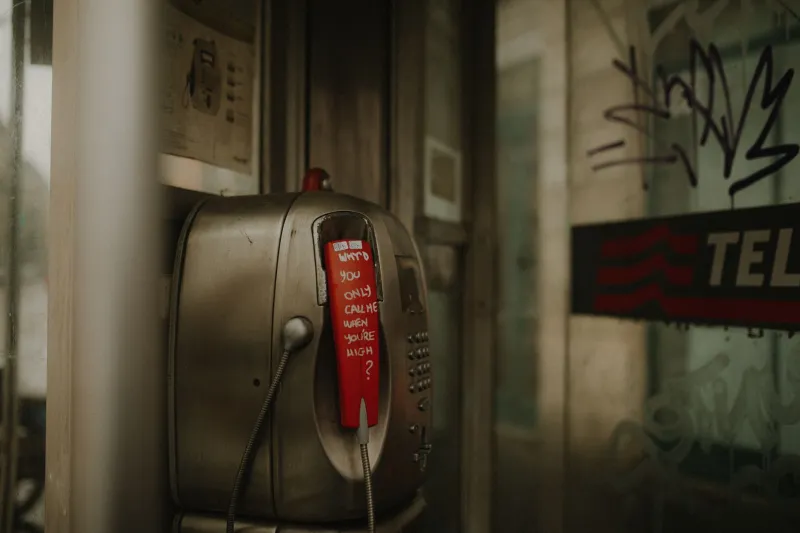
There's a phone booth on the corner of a block in Albuquerque that hasn't made a call since maybe 2009. The handset's been gone for years. The directory slot is stuffed with old takeout menus and one dried-up spider. But on the first Saturday of every month, someone tapes a small silver gelatin print to the inside glass — a new image every time, shot on 35mm, developed somewhere nobody's telling you about — and for about a week, people stop. They actually stop and look.
Nobody knows who does it. That's kind of the whole point.
The Booth as Medium
When the last major payphone operator in New York City pulled its final units in 2022, it felt like a eulogy for something that had already been dead a long time. But scattered across the US — in strip mall parking lots, outside laundromats in Tucson, along rural highways in Kentucky — booths and kiosks still stand. Rusted. Graffitied. Structurally dubious. Completely useless by any tech industry metric.
Which is exactly why a certain kind of photographer fell in love with them.
The movement — if you can call something this decentralized a movement — doesn't have a name or a manifesto. It lives mostly in word of mouth, in handwritten notes left alongside prints, and in the occasional grainy documentation that floats through private group chats. But the core practice is consistent: find a booth, use it. As a darkroom, as a display case, as a developing tank, as a frame for a photograph that exists nowhere online.
"The booth is already a container," says one photographer who goes by Marta V., operating somewhere in the Pacific Northwest and communicating exclusively through a PO box. "It was built to hold a conversation between two people who couldn't see each other. I'm just continuing that tradition with images instead of voices."
Red Light in a Phone Kiosk
The logistics alone are worth pausing on. Some practitioners have rigged portable red-light setups small enough to fit inside a standard booth frame, using the enclosed glass panels to block ambient light during short development windows. Others use the booths purely as installation sites — developing their work elsewhere and returning to hang it in the dead of night. A few have documented using the shallow metal shelf where the phone book used to sit as a tray for quick print-out chemistry, working fast before dawn, leaving the image to dry against the glass.
It sounds insane. It also kind of works.
The results aren't always technically perfect. Grain is heavy. Contrast goes wherever it wants. Occasionally a print gets rained on or torn down within hours. But that impermanence is baked into the philosophy. These aren't archival objects. They're dispatches.
"I don't want anyone to save it," wrote one anonymous contributor in a note found pinned next to a print in a booth outside a Dollar General in rural Mississippi. "I want you to look at it right now, while it's here, and then let it go."
Against the Feed
It would be easy to read all of this as nostalgia — a bunch of film nerds fetishizing obsolete infrastructure because the internet made everything too easy. But spend any time with the people involved and a sharper edge comes through.
Several practitioners have spoken explicitly about surveillance as the thing they're pushing against. Phone booths, ironically, were once one of the most surveilled forms of communication in America — wiretapped, staked out, catalogued by law enforcement going back to the mid-20th century. Now they're among the few public spaces where a person can stand without being tracked, scanned, or fed into a facial recognition database. No app is monitoring the corner booth outside the old Kmart. No algorithm is deciding who sees the print taped inside it.
"I shoot digital for work," admits one photographer who identifies only as D. Reyes, based somewhere in Chicago's southwest side. "Everything I shoot for work is tagged, geolocated, backed up to three clouds, and optimized for engagement. The booth stuff is the opposite of all that. It exists in one physical place, at one moment in time, and then it's gone. That's not a limitation. That's the whole freedom."
The surveillance angle isn't just rhetorical. A handful of practitioners have specifically chosen booths located in areas with heavy CCTV presence — outside government buildings, near transit hubs — as a way of placing handmade, un-trackable images directly inside the architecture of monitoring. A print of a face, developed by hand, hung in a box that no algorithm can index. It's a small gesture. It's also not nothing.
The Strangers Who Find It
What nobody fully anticipated was the community that started forming around the work — not among the photographers, but among the people who stumble onto it.
In Philadelphia, a woman who found a print in a booth near her bus stop left a handwritten response note. Someone else added to it. Within two weeks, the booth had become an informal correspondence wall, strangers leaving messages for other strangers who would pass through the same corner at different hours. The photographer who started it hadn't planned any of that. They just came back to find it.
Similar things have happened in Oakland, in Memphis, in a small town in Vermont where the booth sits outside a post office that's only open three days a week. People photograph the prints on their phones — the irony is not lost on anyone — but they also just stand there and look. Sometimes they take the print with them. Sometimes they leave something behind.
"There's this moment," says Marta V., "where someone realizes the thing they're looking at wasn't made for a screen. It was made for them, specifically, standing in that specific spot. That hits different than anything you're going to find in your feed."
What the Booth Holds
The subjects vary as widely as the practitioners. Portraits of unhoused neighbors. Landscapes shot through cracked windshields. Double exposures that layer faces over highway overpasses. Abstract darkroom experiments that barely read as photographs at all. Some prints come with titles handwritten in pencil on the back. Most don't.
What they share is a refusal to exist on the internet's terms. No metadata. No engagement metrics. No comment section. Just silver halide on paper, taped to glass, waiting for whoever walks by next.
America's dead phone booths were supposed to be just infrastructure rot — the physical evidence of a technology the culture left behind. Turns out some people saw them as something else entirely. Not gravesites. Galleries. Not monuments to obsolescence. Invitations.
The booth on that Albuquerque corner will have a new print up next Saturday. You'd have to be there to see it. That's the whole idea.