Flip It Over: The Record Collectors Who Made a Religion Out of the Songs Labels Threw Away
Somewhere in a storage unit outside Memphis, there are roughly 4,000 seven-inch singles organized by a system that only one person on earth fully understands. The owner, a 58-year-old retired postal worker named Gene, has been collecting for 35 years. He is not interested in the A-sides. He has never been interested in the A-sides.
"The A-side is what the label wanted you to hear," he says, pulling a worn cardboard sleeve from a milk crate. "The B-side is what the artist wanted to make."
This is the gospel according to B-side believers, and it is spreading.
The Reject Pile as Cultural Archive
For most of the 20th century, the B-side was a dumping ground. When a label pressed a single, the A-side was the commercial bet — the track they promoted, the one they pushed to radio, the one that got the artist on television. The B-side was filler space, and labels used it accordingly. Sometimes they tossed on an album cut that didn't fit anywhere else. Sometimes they buried a demo that the artist loved and the A&R department tolerated. Sometimes — and this is where it gets interesting — they accidentally released something genuinely strange.
Regional soul labels in the South pressed singles with deeply weird instrumental B-sides that sounded like they were recorded in a different decade. Chicago house producers in the early '80s used flip sides to experiment with tempos and textures that wouldn't have made it past a program director. Country artists in the '60s tucked rockabilly experiments onto B-sides because their labels wanted them to stay in their lane on the front end. The result, across decades of commercial music, is an enormous shadow archive of American sound — experimental, unpolished, occasionally transcendent — that the industry itself largely forgot.
The collectors who hunt it are not forgetting anything.
The Swap Meet Circuit
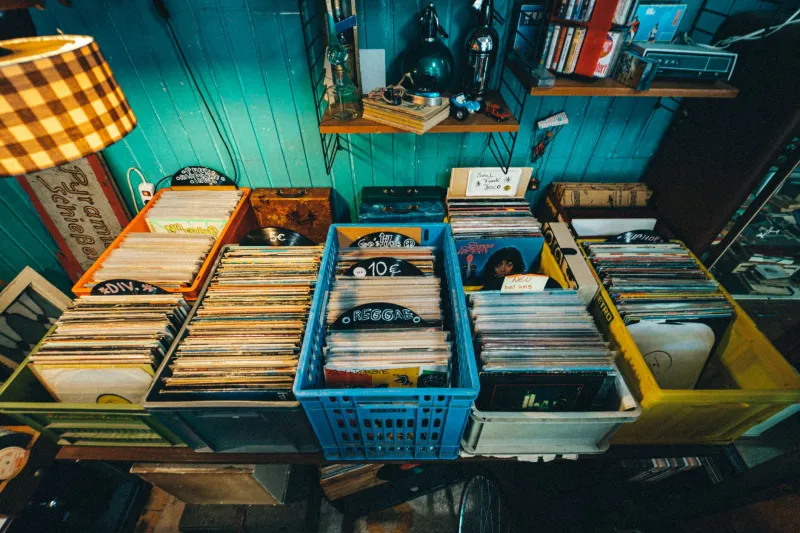
On a Saturday morning in a parking lot outside a VFW hall in suburban St. Louis, around 40 dealers have set up folding tables covered in vinyl. Most of the foot traffic is browsing album covers, flipping through classic rock and soul LPs. But a small cluster of people — maybe six or seven — are working a different section entirely, pulling seven-inch singles from bins with a focused intensity that looks less like shopping and more like research.
This is where the B-side community operates. Swap meets, record fairs, estate sales, storage unit auctions. The places where vinyl moves without context, where a dealer might not know what they're selling, where a genuinely rare flip side can surface in a bin labeled "45s — $1 each."
"You develop an eye for it," says Renata, a 34-year-old from Kansas City who's been hunting B-sides for about a decade. She pulls a sleeve, checks the label on the back, replaces it. "You learn which labels were sloppy with their flip sides in interesting ways. You learn which artists had more creative control than their contracts suggested. You start to see patterns."
Renata runs a modest online forum — membership by request only, a few hundred members — where collectors share finds, debate authenticity, and occasionally trade or sell. It's not a marketplace, exactly. It's more like a reading group for people who communicate in catalog numbers.
The Online Underground
Beyond the physical swap meet circuit, B-side culture has its own digital infrastructure, and it looks nothing like the slick vinyl communities on Reddit or the algorithm-optimized record nerd content on YouTube. The real action happens in Discord servers with invite-only channels, in Facebook groups that haven't updated their cover photos since 2015, in email threads that have been running continuously for years.
These spaces are where knowledge actually transfers — where someone in Detroit who found a pressing of a 1971 Northern Soul single with an unreleased instrumental on the back can connect with someone in Portland who's been looking for that exact record for eight years. The transactions that happen in these communities are as much about information as they are about the physical object. The story of the record — where it came from, what the circumstances of its recording were, why it ended up where it did — matters as much as the grooves.
"People think collecting is about ownership," says DJ Pharaoh, a Houston-based producer and collector who's been digging for B-sides since the late '90s. "It's really about knowledge. The record is just the proof that you know something."
Sampling from the Reject Pile
What started as a preservation obsession has quietly begun to reshape contemporary music, and the people responsible for that influence are rarely credited. Producers who dig for B-sides have been pulling samples from flip sides for decades — hip-hop and electronic music in particular have a long history of finding their most interesting raw material in the songs nobody promoted.
Pharaoh, who produces under a name he keeps deliberately low-profile, has built most of his production catalog on B-side samples. A soul ballad's forgotten instrumental flip becomes a beat. A regional funk band's throwaway instrumental becomes a loop that sounds like nothing else in contemporary music because it genuinely came from nowhere — pressed once in a regional market, distributed locally, never heard again until someone dug it out of a bin.
"The industry threw away so much," he says. "They were trying to sell one song and they accidentally preserved twenty years of sonic experimentation on the back of it. We're just returning the favor."
Some of those rediscovered tracks are now circulating more widely than they ever did on original release. Streaming platforms, ironically, have given B-sides their broadest audience — though the collectors who found them tend to have complicated feelings about that. There's something lost when a record that survived decades of obscurity suddenly has 200,000 Spotify plays. The scarcity was part of the meaning.
Why the Obsession Holds
Gene, back in his Memphis storage unit, holds up a seven-inch with a hand-stamped label. It's a 1968 pressing from a small Tennessee soul label that folded before the decade ended. The A-side is a straightforward ballad. The B-side is three minutes of something that sounds like the band wandered into free jazz by accident and decided to stay.
"Nobody wanted this," he says, which is the highest compliment he knows how to pay.
That's the core of it, really. B-side collecting is a practice built on the belief that the industry's judgment was wrong — that the songs dismissed as filler, buried on flip sides, pressed in small quantities and shipped to regional distributors who forgot about them, were often the most interesting songs in the room. It's a counter-history of American popular music written in catalog numbers and dead wax etchings, assembled one crate at a time by people who find something deeply satisfying in rescuing what everyone else threw away.
The mainstream never flipped the record over. These people never stopped.