Gone by Morning: The Sidewalk Chalk Artists Making Masterpieces the Rain Gets to Keep
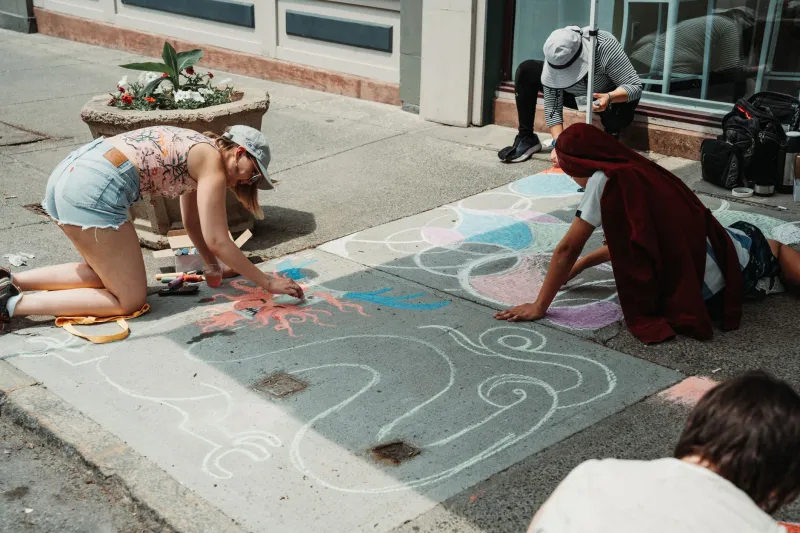
Somewhere in downtown Denver, a woman named Celestine is on her knees. It's 6 a.m. on a Tuesday, the air still cool enough to see her breath, and she's been out here since four. Around her, a 40-foot rendering of a crumbling Mesoamerican temple — rendered in soft ochres, deep reds, and shadow-heavy blacks — is taking shape on the sidewalk outside a shuttered department store. By Thursday, after two days of foot traffic and a forecast that promises afternoon showers, every bit of it will be gone.
Celestine doesn't seem bothered by this. In fact, she built her whole practice around it.
"If I made something permanent, I'd be too precious about it," she says, dragging a fat stick of raw umber across the concrete in one long, confident stroke. "The clock running out is what makes me go harder."
This is the quiet logic that drives an entire subculture of sidewalk chalk artists operating across American cities — from Philadelphia's Old City blocks to the French Quarter edges of New Orleans to the tech-corridor sidewalks of Austin. They are not a formal movement. There's no union, no governing body, no group chat that holds them all together. But talk to enough of them and you start to hear the same ideas echo back in different voices: that ownership is overrated, that a crowd of strangers stopping mid-commute is worth more than a gallery wall, and that the most honest thing art can do is admit it won't last forever.
The Toolkit, The Hustle
If you picture sidewalk chalk as the fat, pastel sticks you used on your parents' driveway in 1998, think bigger. Most serious practitioners work with professional-grade chalk pastels, chalk paint, and in some cases custom-blended pigment blocks that cost anywhere from $15 to $80 per stick. A single large-scale piece can eat through $300 to $600 in materials before the artist ever touches the pavement.
Funding that is its own creative act. Some artists, like Marcus Webb in Philadelphia, hustle festival contracts — outdoor markets, neighborhood block parties, corporate activations that want something visually spectacular and don't mind that it disappears when the event ends. Others, like a collective called Pavement & Paper out of Chicago, run a Patreon where supporters pay a monthly rate to get time-lapse videos of completed works, behind-the-scenes photos, and occasional prints of digital photographs taken at peak completion.
"The photograph is kind of a souvenir," says one of Pavement & Paper's members, who goes by Soleil. "But we're very clear with people: the photograph is not the art. The art was the thing you had to be there to see."
That distinction matters to them. A lot.
Permits, Pavement, and the Gray Area
Legality is, charitably, complicated. Chalk is water-soluble, which means most municipalities technically don't classify it as vandalism the way spray paint would be. But "technically" is doing a lot of work in that sentence. Several artists interviewed for this piece described being approached by police or city workers mid-creation — some encounters ending in warnings, a few ending in fines, one ending in a conversation that turned into an official city arts commission grant.
Celestine has operated in all three modes. "I've had cops take photos for their kids and I've had cops tell me to pack it up," she says. "It really depends on the block, the day, who's watching."
A small number of practitioners have figured out how to work within city systems without losing their edge. Webb in Philadelphia has built relationships with the city's Mural Arts Program, which sometimes provides informal cover — not quite a permit, but a professional affiliation that tends to smooth things over when questions arise. Others deliberately avoid any official entanglement, viewing the legal ambiguity as part of what keeps the work honest.
"The second you need permission to make something, you start making something different," argues a Chicago-based artist named Dayo, who has never applied for a permit in six years of working public pavement. "You start thinking about what the city wants. I'm not interested in what the city wants."
The Crowd Is the Review
What's striking about sidewalk chalk work, especially at scale, is how differently it lands in public space compared to gallery art. There's no velvet rope, no price tag, no white wall to signal that you're supposed to be impressed. People walk into it without context. They look down and suddenly there's a photorealistic ocean floor, or a cracked-open pomegranate with seeds that seem to roll off the edge of the curb, or a portrait of a neighborhood elder rendered so large it takes ten seconds just to take in the whole face.
The reactions tend to be immediate and unguarded in a way that gallery openings rarely produce. Kids drop to their hands and knees to touch the texture. Old men stand with their arms crossed and then slowly uncross them. Somebody always cries, usually at the portraits.
"That's the whole thing for me," says Soleil. "In a gallery, people perform their reaction. On the street, they just have it."
The social media dimension is unavoidable — these pieces get photographed constantly, and the images circulate — but most of these artists treat virality as a side effect, not a goal. Celestine doesn't post her own work until after it's been rained away. "I want people to come find it," she says. "Not just double-tap it."
Why the Impermanence Is the Point
There's a broader argument embedded in this whole scene, one that feels particularly charged right now, in a cultural moment when everything is being archived, tokenized, monetized, and preserved. NFTs promised to make digital art permanent and ownable. Museums fight over provenance and acquisition. Collectors store paintings in climate-controlled vaults no one ever visits.
Sidewalk chalk artists are doing the opposite of all of that, deliberately and on purpose.
"I think people are exhausted by the idea that everything has to be kept," says Dayo. "Some things should just happen and then be gone. That's not a failure. That's a complete thing."
There's something almost Buddhist about it, though most of these artists would probably roll their eyes at that framing. It's less about spiritual detachment and more about a practical, clear-eyed critique of how art gets valued in this country — by who owns it, where it hangs, what it sold for, whether it'll appreciate. Chalk on pavement can't play that game. It opts out by design.
Celestine finishes the temple's shadow line and sits back on her heels. A guy in a delivery uniform stops behind her, coffee in hand, mouth slightly open. He stands there for a full two minutes without saying anything. Then he takes a photo and keeps walking.
She watches him go and starts mixing colors for the next section.
"That's it," she says. "That's the whole thing right there."
By Thursday, the rain will take it. She'll already be thinking about what comes next.