No Sign Out Front: The Hidden Costume Houses That Keep Underground Theater Dressed
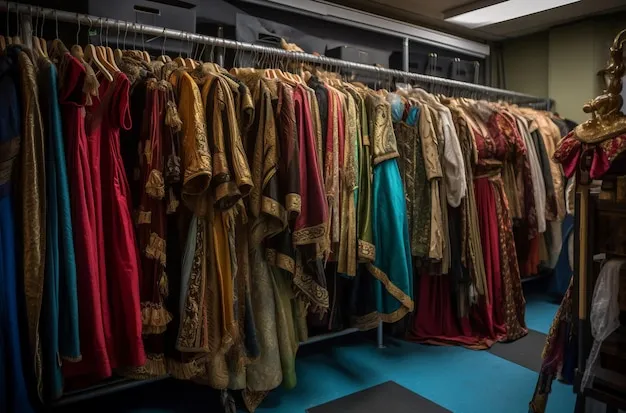
Photo: vintage costume rack theatrical wardrobe backstage clothing collection, via img.freepik.com
The phone rings once, twice. A voice answers — not a voicemail, an actual person. You explain who you are, who referred you, what you need. There's a pause. Then an address, sometimes a cross street, sometimes just a neighborhood and a description of a door. That's how you get in.
Across the US, in cities with thriving underground performance scenes, a strange and largely invisible infrastructure has grown up around the question of what people wear onstage. Not Broadway onstage. Not regional theater onstage. The other stages — the parking lot stages, the warehouse stages, the drag shows in the back of bars, the site-specific performances in places that have never hosted a performance before. These communities need costumes, and mainstream rental houses aren't built for them.
So they built their own.
What a Real Costume House Looks Like
Forget the theatrical supply companies with their laminated catalogs and their minimum rental periods. The operations we're talking about are something else entirely. They tend to live in spaces that were originally something else — a former print shop in Baltimore, a converted apartment back room in Detroit, an actual storage facility in the outer boroughs of New York where the proprietor has negotiated a kind of informal sublease situation that works until it doesn't.
Inside, the density is staggering. Racks that go ceiling-height, packed with garments organized by a system that only makes sense to the person who built it. Bins of accessories that have been sorted, resorted, and re-sorted over decades. Wigs on styrofoam heads stacked four and five high. Shoes in clear plastic bags with handwritten labels. And everywhere, the particular smell of old fabric, cedar, and something faintly theatrical that you can't quite name.
The person running it — and it's almost always one person, maybe with a part-time helper — knows where everything is. Ask for a specific piece, describe what you're going for, explain the character, and watch them disappear into the racks and come back with something you'd never have thought of but immediately recognize as exactly right.
The Community That Makes It Work
These shops don't advertise because they don't need to. Their customer base is a self-selecting network of people who already know each other — drag performers, experimental theater collectives, queer performance artists, avant-garde dance companies, low-budget film crews, and the occasional haunt operator who needs something genuinely weird and knows better than to look at Spirit Halloween.
The referral network is tight and intentional. You don't give out the number to just anyone. Not because the proprietors are secretive for its own sake, but because the whole operation depends on a certain level of mutual trust and community accountability. These are often one-of-a-kind pieces. Handmade garments. Things that can't be replaced. The people who borrow them need to understand what they're handling.
In Chicago, a costume house that's been operating in some form since the late 1980s has dressed performers who went on to significant careers without ever getting a credit or a mention. The proprietor doesn't seem to mind. The work isn't about recognition. It's about keeping the scene dressed, keeping the weird stuff in circulation, keeping the community resourced.
The Artifacts Problem
Here's something that doesn't get talked about enough: a lot of what's hanging in these shops is historically significant in ways that no institution has bothered to acknowledge. The costume from a landmark drag performance in 1994. The suit worn by a performance artist whose work defined a specific moment in queer culture. The handmade ensemble that traveled with an experimental theater troupe through fifteen cities on a shoestring budget in 2003.
These aren't just clothes. They're primary sources. They carry history in their seams.
And they're being preserved — imperfectly, informally, on a shoestring — by people who simply refused to let them disappear. Some proprietors are explicit about the archival dimension of what they're doing. They've started turning down rental requests for certain pieces, keeping them as collection items rather than active stock. Others maintain everything in circulation, believing that objects should be used, that a costume sitting in acid-free tissue paper in a museum box has lost something essential.
Both positions make sense. Neither has a budget.
The Economics of Invisible Infrastructure
Rental fees at these operations tend to be sliding scale, negotiated informally, and regularly waived entirely for community members who are broke but doing important work. This is not a business model that generates profit. It's a resource that generates community.
Most proprietors supplement with other income — alterations, custom construction, occasional work for commercial productions that need something specific and unusual. A few have found ways to make the math work through informal membership structures, where regular users contribute a flat monthly amount that keeps the lights on. None of them are getting rich. Several are operating at a loss they cover personally because the alternative is shutting down.
What keeps them going is harder to quantify. Watch a proprietor help a young drag performer find their first real stage look — something that fits, something that works, something that makes the performer stand up straighter the moment they put it on — and you start to understand.
The Succession Question
The same question haunting underground zine libraries and analog darkrooms is haunting these costume houses: what happens when the person holding it all together can't anymore?
Some proprietors are actively working on answers. They're documenting collections, building informal boards of stewards, having the hard conversations about what should happen to 40 years of accumulated costumes when they're gone. Others are avoiding the question entirely, which is its own kind of answer.
A few cities have seen informal coalitions form around the question — performance communities coming together to collectively take on the infrastructure that one person has been carrying alone. It's messy and complicated and sometimes it works.
The pieces are too important to lose. The communities that depend on them know it. Whether that knowledge translates into the sustained collective action required to actually preserve these institutions is the ongoing experiment.
Why Underground Theater Needs Its Own Infrastructure
Mainstream costume rental exists to serve mainstream production. The aesthetic vocabulary, the sizing, the organizational logic — all of it is built around conventional theater, film, and event production. Underground performance communities don't fit that mold. Their work is weirder, queerer, more specific, more political, more interested in transformation than representation.
They need different stuff. And they need people who understand why they need it.
The hidden costume houses are that understanding, made physical. They're the material infrastructure of scenes that the mainstream doesn't acknowledge, serving communities that have always built what they needed because nobody was going to build it for them.